Historical Novel Society Interview
INTERVIEWED BY KEIRA MORGAN
Born on the Island of Jersey, Vince Rockston studied physics at Imperial College London, then moved to Geneva as a Research Associate at CERN. He moved into IT and later technical writing. He now enjoys retirement in a beautiful village in Switzerland, where he enjoys caring for refugees, maintaining several websites and helping as a classroom assistant, among other activities. He writes dramatic stories set in distant times and places in which young people come to grips with timeless spiritual questions. Greet Suzon for Me is his most recent release.
How would you describe this book and its themes?
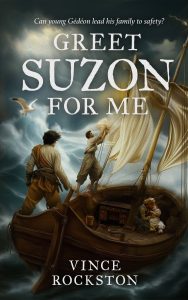
Gédéon’s papa and little sister Rachel have been abducted by King Louis XIV’s dragoons – just because they are Huguenots. Will Gédéon be able to elude his pursuers and bring his family to safety?
What attracted you to writing historical fiction?
I believe storytelling is the best way to communicate any message. Since human nature hasn’t fundamentally changed over the centuries, a serious work of historical fiction allows us to peer into the hearts and aspirations of people from earlier ages and find inspiration from how they tackled the challenges and opportunities they faced.
What were their motives? How were they influenced by their circumstances and the prevailing attitudes? How did they overcome the difficulties they faced? Both of my books deals with these questions.
Greet Suzon for Me takes place during the reign of Louis XIV. Gédéon, the young protagonist, witnesses the cruelty of agents of the Church and must tackle questions of morality and faith in the context of religious persecution.
Why did you choose the expulsion of the Huguenots from France as your period and theme?
Through helping many refugees from the Middle East and Afghanistan, I have learned of the horrors that drive them to abandon their homes and endure unbelievable trauma on their journey to seek a new life in Europe. Therefore, a story set during the persecution of Huguenots by the Sun King struck me as an allegorical way to draw readers’ attention to the realities of the contemporary refugee crisis. The issues around political and religious conflict, the despair and agony of leaving one’s loved ones to seek a new life in an unknown land and the dangers faced on the way are parallel.
An example from my experience: a Syrian man fled Aleppo after his wife was wounded in a bombing and his friend murdered for being Christian. With no maritime experience, he captained a crowded dinghy from Turkey to Greece, watched families drown from a nearby vessel, ran out of fuel, waded to a deserted island, and finally reached Switzerland, where his family later joined him after a perilous escape through Lebanon.
Why did you select Normandy and the Channel Islands as the main settings for the action in your book?
I have Huguenot maternal ancestors who fled from Normandy to Jersey. Before my mother started school, she still spoke the Norman French dialect known as Jèrriais. These French refugees left a permanent mark on the culture and economy of the Channel Islands. I was born and grew up in Jersey, so I was familiar with its history and geography, including the rocky islet of Les Écréhous, which I visited with a school friend in his uncle’s fishing boat.
Which of the many characters in your novel challenged you the most and why?
Suzanne d’Albert, Gédéon’s maman. At first, I had unwittingly portrayed her as a stereotypical neurotic mother of questionable faith who was rather hysterical and a burden to the family. I had to redefine her as the educated woman she was, who had enjoyed a unique upbringing in Parisian high society, and who was, in fact, a stalwart stay of the family.
Who is the intended audience for your novel? Do you have an age group in mind?
Greet Suzon for Me targets thoughtful men and young adults with an interest in European history and the fate of refugees, especially those struggling to make sense of their own faith and the religious conflicts around them.
How have your personal and professional life experiences contributed to writing this novel?
I have long been fascinated by the religious and political forces that shaped Western society, from the rigid dominance of the Roman Church through various reform movements and the Renaissance’s scientific and cultural awakening to today’s complex, liberal postmodern world. I hope the current generation may learn from past mistakes to foster a healthy, morally upright way of life in which different religious perspectives are accepted and tolerated, when they are genuine at the core.
Why do you emphasise religious questions in your book?
I am a convinced Christian, immersed in ecumenical activities involving four different denominations in my local community. From this experience, I believe that many religious conflicts arise from misunderstandings and from secondary issues of how to worship God. Insisting on particular church buildings, forms of service, styles of music or ecclesiastic attire can become serious distractions from the central issue of knowing and following God in one’s day-to-day life.
Gédéon was brought up to follow a strict Protestant faith, which at first meant little to him. But his sister’s sincere love for Jesus impressed him deeply.

Monsieur Corbet, Gédéon’s mentor in Jersey, summed it up as follows: “The important thing is to believe Jesus is the Son of God; that He died and rose again; that He forgives us. It doesn’t matter in what sort of building we worship, nor whether we have an organ to accompany our hymns, or no hymns at all.”
Many people in today’s multi-ideological world are struggling with what to believe. They find assertions that everything just arose by chance preposterous, but they can’t work out which of the many contemporary faiths and non-faiths on offer are valid. Through Gédéon’s experiences, I wish to emphasise that outward symbols may be disregarded when one’s central faith is genuine.
What is the best writing advice you have to share?
Hire a professional developmental editor and follow their advice, even as you cry over the darlings you must kill on the way. Editing is hard, painful work and best accomplished with the help of a dispassionate observer.
What is the last great book you read?
Katharina Fortitude by Margaret Skea.
The original interview is here.