B is for Benoist – Historian of the Edict of Nantes
A contribution to the #AtoZchallenge 2024
![Élie Benoist in later years in Delft [Johannes Klopper]](https://vincerockston.com/wp-content/uploads/2024/03/Elie_Benoit-216x300.jpg)
Imagine being thrown out of your own country as a rebel with fifteen days’ notice, and having to leave your daughters behind. This happened to Pastor Élie Benoist when, in 1685, King Louis XIV revoked the Edict of Nantes.
Although from a humble background, Élie Benoist was a learned theologian. In 1665, he was appointed as one of the pastors of the Huguenot congregation in Alençon, Normandy. The original temple in the downtown area had been ordered demolished the year before he arrived. Its successor, with a capacity for 1,500 worshippers, was built on rising ground in Lancrel, just outside the city.
Benoist’s marriage was not a success. A biography notes that his wife had “all the faults which can be serious for a peace-loving husband: miserly, rash, quarrelsome, undependable and changeable, with a tireless love of argument. For forty-seven years, she made her husband miserable in every terrible way.”
The pressure increases
Pressure against Huguenots was mounting in many parts of France. A colleague of Benoist’s was banished for citing the biblical admonition, “we must obey God rather than men.” Although a friendship had developed between Benoist and the local Intendant1, which stood the minister and the congregation in good stead for a time, severer tests lay ahead. In August 1691, the influential Jesuit writer and orator Père de la Rue, a persistent adversary of Benoist, incited a riot against the Huguenot pastor in the Lancrel temple. Many Protestant believers grew nervous and tried to escape to the United Provinces, England or even the New World.
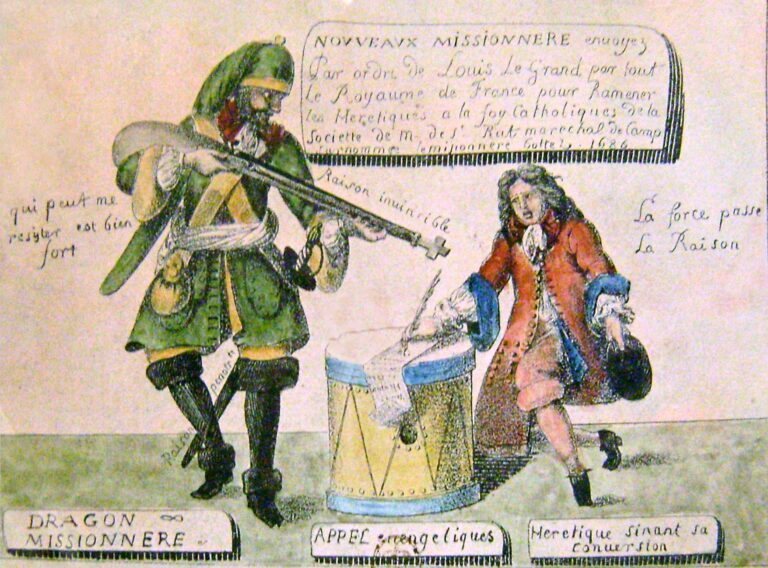
In 1684, out of concern for the safety of his parishioners, Benoist went into hiding in Paris. He was there when Louis XIV repealed his grandfather King Henry IV’s concessions toward adherents of the Huguenot faith. Suddenly, pastors and their wives were granted passports and had to leave the country within two weeks. But the Benoists’ two surviving teenage daughters, who had remained in Alençon, were left behind.
Flight to the United Provinces
Benoist escaped to the United Provinces and was appointed a minister of the Walloon congregation in the city of Delft. There he made a name for himself as an erudite and fervent preacher. But his concern for his former parishioners in Alençon continued. He wrote to them, exhorting those who had denied their faith, to take courage and cease their hypocrisy. As resistance grew, and eight of the elders were imprisoned, many others fled to foreign lands. Some found their way to Delft, where they publicly repented their abjuration and were received back into communion. Among these were Benoist’s daughters.
It was a period of intense activity. Benoist strongly defended the retreat of the pastors into exile against those who charged them with cowardice and desertion. At the same time, he worked on a secret project to smuggle ministers back to France disguised as peasants, into areas where they were not known, in order to provide support and leadership to their stricken people.
Authorities in France, sensitive to the adverse publicity occasioned by the flight of tens of thousands of refugees, criticised the rebellious disloyalty of the Reformed subjects of the king. Benoist felt the moment had arrived for their vindication. This was his main incentive for writing his major work – the one for which he is primarily known – his History of the Edict of Nantes2. This massive, five volume treatise offers a judicial perspective on Huguenot victimhood in France, tracing the dismantlement of Protestant communities over the course of the 17th century.
Élie Benoist died in Delft in 1728.
At the beginning of the book ‘Greet Suzon for me’, Élie Benoist is attacked during a culte in the Alençon temple. The book, which is due to be published in 2025, is about a Huguenot family’s perilous escape from France to Jersey.
- A provincial civil servant with jurisdiction over local finances, policing and justice, appointed to supervise and enforce the king’s will. ↩︎
- Élie Benoist, Histoire de l’Édit de Nantes, contenant les choses les plus remarquables qui se sont passées en France avant & après sa publication, Delft 1693, 1695. ↩︎
Here are all the A-Z posts: A B C D E F G H I J K L M N O P Q R S T U V W X Y Z